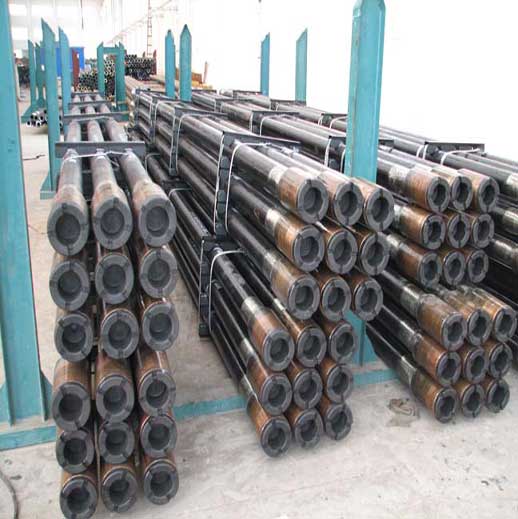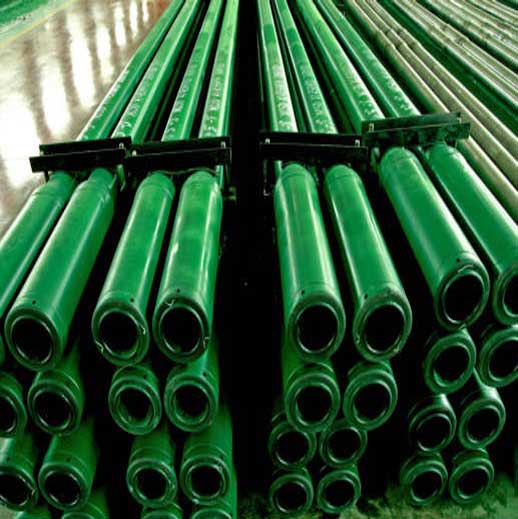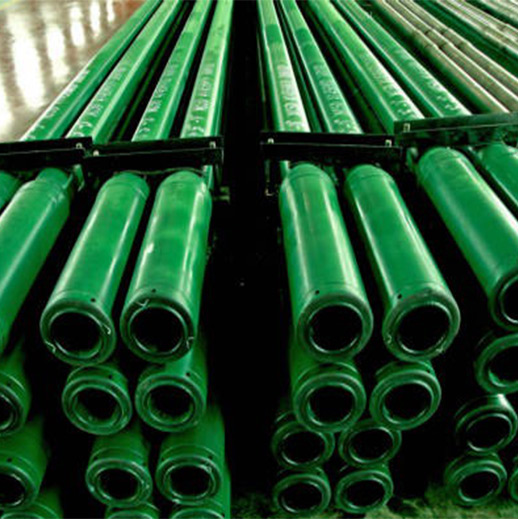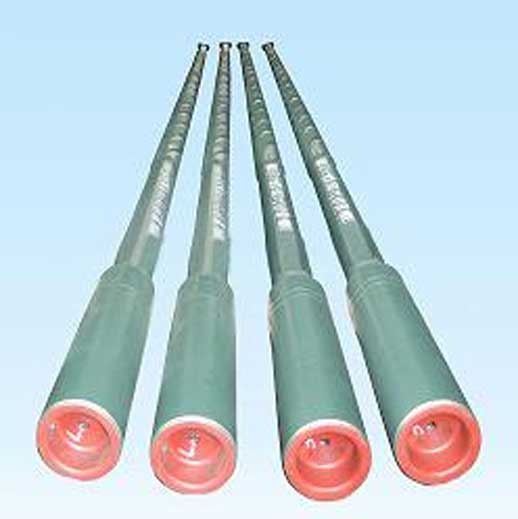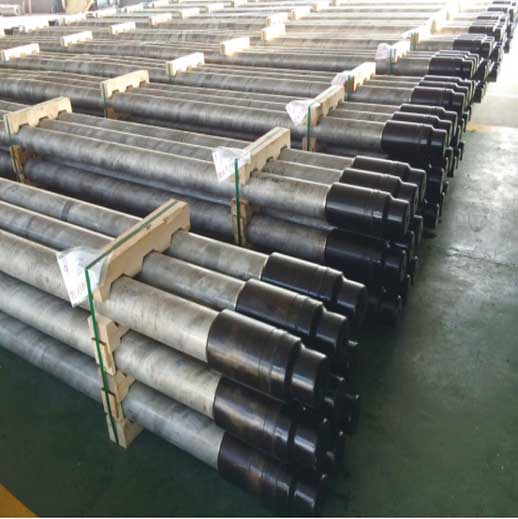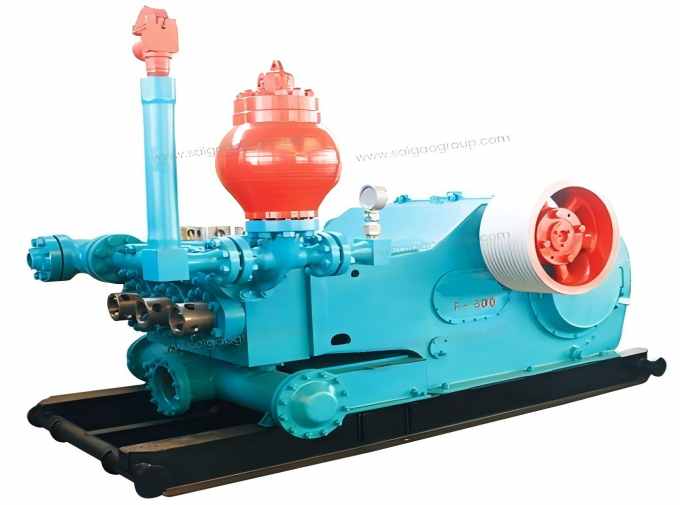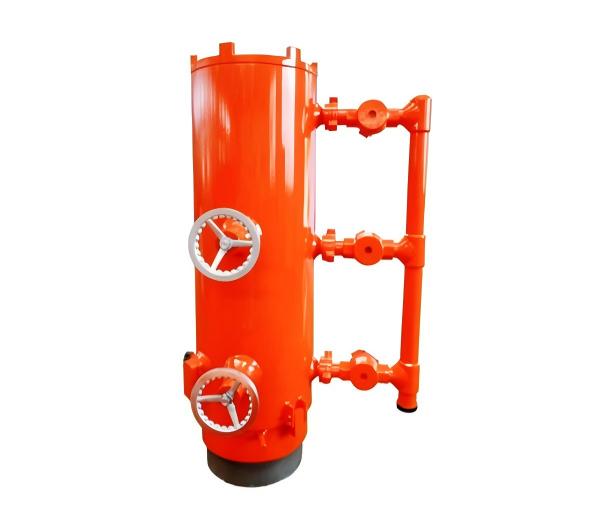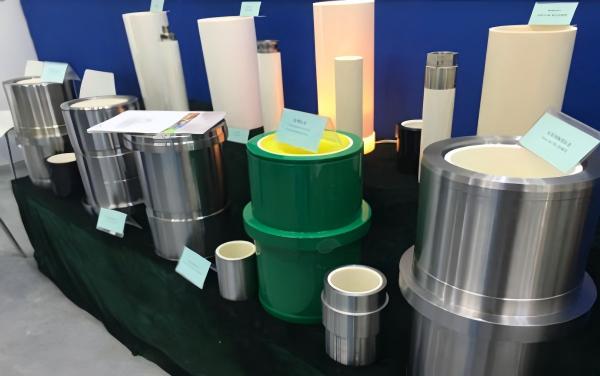

The drill pipe is a steel pipe with a tail thread for connecting the surface equipment of the drilling rig and the drilling equipment or bottom hole device at the bottom of the drilling. The purpose of the drill pipe is to transport the drilling mud to the drill bit and to raise, lower or rotate the bottom hole device with the drill bit. The drill pipe must be able to withstand large internal and external pressures, distortions, bends and vibrations. The drill pipe can be used multiple times during the oil and gas extraction and refining process. The drill pipe is divided into three types: a square drill pipe, a drill pipe and a weighted drill pipe. The connection sequence is kelly + drill pipe (n, determined by well depth) + weighted drill pipe (n, determined by the drill combination design). The classification of the drill pipe, the drill pipe joint, the drill pipe specifications, and the steel grade and strength of the drill pipe are detailed.
The usual components of the drill string are: drill bits, drill collars, drill pipes, stabilizers, special joints and kelly bars.
Starting the drill bit;
Applying a bite pressure;
Transmitting power;
Conveying drilling fluid;
Carry out special operations: squeezing cement, handling downhole accidents, etc.
API standard E75 to S135 steel grade, series oil drill pipe with outer diameter from 2 3/8" to 6 5/8" and double shoulder joint drill pipe with high torsion resistance and special steel for sulfur oil well Grade BNK C95S drill pipe. It is mainly used in the construction of deep wells, horizontal wells and large displacement wells in oil and gas exploration and development.
The drill pipe is a threaded steel pipe at the end for connecting the rig's surface equipment and the drilling equipment or bottom hole device at the bottom of the drilling. The purpose of the drill pipe is to transport the drilling mud to the drill bit and to raise, lower or rotate the bottom hole device with the drill bit. The drill pipe must be able to withstand large internal and external pressures, distortions, bends and vibrations. The drill pipe can be used multiple times during the oil and gas extraction and refining process.
The light pipe and the original steel pipe are made into a drill pipe after a plurality of processing steps. First, through the treatment of the thickening process of the steel pipe, the outer surface of the light pipe is bent inward, and the wall of the steel pipe is thickened. Next, threading is performed and plated with copper that increases strength. A non-destructive quality control test is then carried out, followed by welding of the pipe joints. The tube then undergoes welding heat treatment and final welding to eliminate weld residual stress. Other tests, including hardness testing, stress testing and non-destructive testing, are required for the finished steel pipe before the finished drill pipe is painted and packaged.
The length of the drill pipe is generally about nine meters.
Classification:
The drill pipe is divided into three types: a square drill pipe, a drill pipe and a weighted drill pipe. The connection sequence is kelly + drill pipe (n, determined by well depth) + weighted drill pipe (n, determined by the drill combination design).
The kelly is located at the uppermost end of the drill string and is available in both square and hexagonal.
Effect:
when drilling, the kelly cooperates with the center of filling and the center of the turntable to transmit the ground rotation torque to the drill pipe to drive the drill string and the drill bit to rotate;
withstand the full weight of the drill string;
channels for drilling fluid circulation.
The drill pipe is an essential part of the drill string. Its main function is to transmit torque and transport drilling fluid, and the wellbore is deepened by the gradual lengthening of the drill pipe. Therefore, the drill pipe plays an important role in oil drilling.
Structure:
The kelly is composed of upper and lower joints and a pipe body portion. The pipe body part is a square or hexagonal structure (the oil drilling is mostly a square structure); the upper joint is a left-handed female thread (reverse buckle), which is connected with the faucet, and the left-handed female thread prevents the reverse buckle during the rotation; the lower joint It is a right-handed male thread and is connected to the drill pipe. When working, the upper end of the kelly is always above the turntable surface, and the lower part is below the turntable surface.
The drill pipe structure drill pipe is made of no steel pipe, and the wall thickness is generally 9-11 mm; the pipe body and the joint of the drill pipe body and the drill pipe joint are welded together by friction welding.
The weighted drill pipe is similar to an oil drill pipe and is also a hollow steel column with a length of about 10 meters. However, the single weight is heavier than the oil drill pipe, and the wall thickness is 2 to 3 times that of the drill pipe. The weighted drill pipe is connected between the drill pipe and the drill collar to prevent fatigue damage caused by the change of the cross section of the drill string. It can also replace the function of a part of the drill collar, but it is simple to suspend and easy to drill down, which can save the time of drilling down.
According to the American Petroleum Institute (API), drill pipes are divided into three categories according to length (L): the first category: 5.486-6.906m (18-22 ft); the second category (common): 8.230 -9.144m (27-30ft); the third category: 11.582-13.716m (38-45ft). The drill pipe can also be sized according to the outer diameter. Common drill pipe size (D): 88.9, 114.3, 127mm (usually expressed in inch size: 3 1/2" 4 1⁄2" 5") three teel grade and strength of the drill pipe.
The steel grade of the drill pipe refers to the grade of the drill pipe steel, which is determined by the yield strength of the drill pipe steel. The API (American Petroleum Institute) classifies drill pipe steel grades into five grades: D, E, 95 (X), 105 (G), and 135 (S). The higher the drill pipe grade, the greater the yield strength of the pipe and the greater the strength of the drill pipe. In the strength design of the drill string, it is recommended to increase the strength of the drill string by increasing the steel grade without using the method of increasing the thickness.
0531-69959201
lqg18653457231
+86-18653457231
No 12111,Jingshi Road, Lixia District, Jinan City, Shandong Province. P.R. China


 English
  日本語
日本語  français
  Español
  русский
  português
  العربية
  tiếng việt
  ไทย
ไทย  Polska
  română